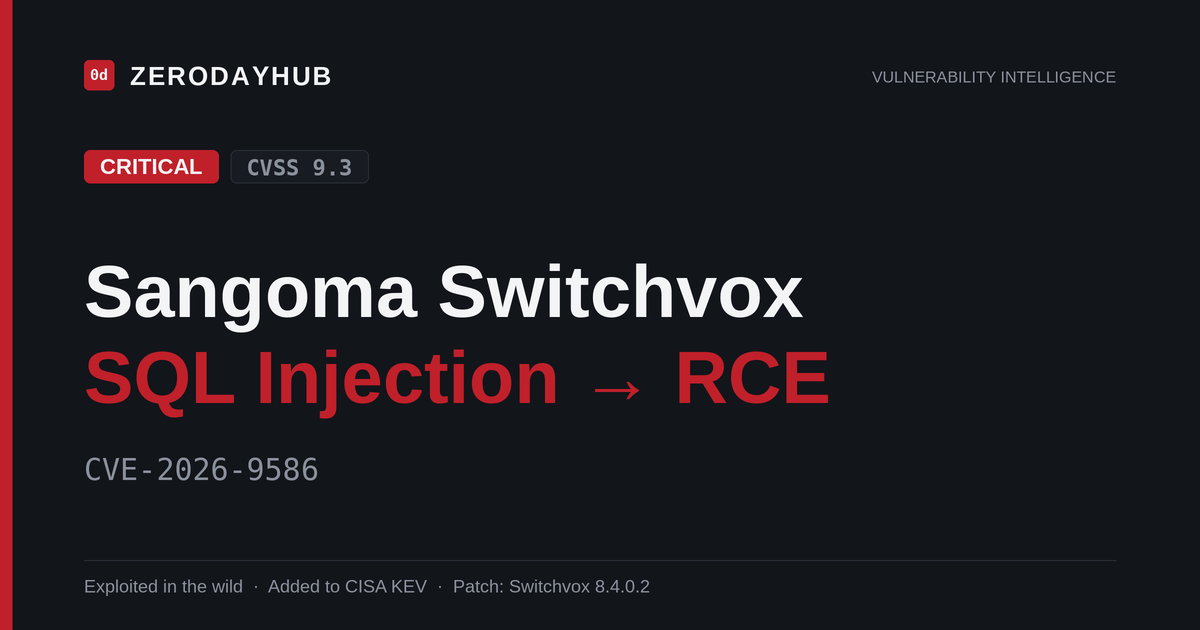
TL;DR — A single unsanitised field in a phone-provisioning endpoint hands the internet a root shell on your phone system. CVE-2026-9586 (CVSS 4.0 9.3, CWE-89) is an unauthenticated SQL injection in Sangoma Switchvox — the widely deployed SMB VoIP/PBX appliance — that an attacker escalates to remote code execution by abusing PostgreSQL’s COPY … TO PROGRAM feature. No login, no user interaction. Horizon3 saw it exploited in the wild from 30 August 2026 to drop reverse shells, and CISA added it to the Known Exploited Vulnerabilities catalog on 2 September 2026 with a 5 September federal deadline. Roughly 4,000 Switchvox systems sit exposed online. If you run one, upgrade to 8.4.0.2 now and hunt for compromise.
What Is the Sangoma Switchvox SQL Injection (CVE-2026-9586)?
Sangoma Switchvox is a widely deployed unified-communications appliance — the IP-PBX that runs phones, voicemail, call routing and conferencing for a large number of small and mid-sized businesses. Because it is a telephony backbone, an appliance most organisations install once and rarely touch, it tends to sit on the network for years with its web interface reachable. CVE-2026-9586 turns that quiet box into an unauthenticated foothold: a remote attacker with no credentials can inject SQL into the phone-provisioning interface and, from there, execute operating-system commands on the appliance.
The flaw carries a CVSS 4.0 base score of 9.3 (Critical) with the vector CVSS:4.0/AV:N/AC:L/AT:N/PR:N/UI:N/VC:H/VI:H/VA:H/SC:N/SI:N/SA:N — network-reachable, low complexity, no privileges and no user interaction, with high impact to confidentiality, integrity and availability. It was discovered by Horizon3.ai (researcher Zach Hanley) as one of twelve distinct Switchvox issues reported to Sangoma, and is tracked under CWE-89, improper neutralisation of special elements in an SQL command. Sangoma quietly shipped the fix in July; the danger changed character in late August, when exploitation began in earnest.
How the Switchvox Exploit Works
In plain terms: Switchvox has a page that supported desk phones talk to when they check in, and it trusts what the phone tells it. One of the values a “phone” can send is its IP address — and Switchvox drops that value straight into a database query without checking it. An attacker just pretends to be a phone, puts database commands where the IP address should go, and the appliance runs them.
The root cause lives in the /pa endpoint handled by PhoneAppsHandler.pm, which processes XML-formatted phone notifications before any authentication is required. The PhoneIP field is extracted from the parsed XML and concatenated directly into an unparameterised SQL string inside a single-quoted context — the textbook SQL injection primitive (CWE-89). An attacker sends an HTTP POST whose body opens with a <PolycomIPPhone> element and smuggles their payload through PhoneIP.
What makes this a full remote-code-execution bug rather than “just” a data-theft one is where the query runs. Switchvox executes it with PostgreSQL superuser privileges, and PostgreSQL superusers can invoke COPY … TO PROGRAM, which pipes query output to an operating-system command. By injecting a COPY (SELECT …) TO PROGRAM '…' statement, the attacker turns the SQL flaw into arbitrary shell execution — for example spawning a reverse shell back to their own host. There are no pre-conditions beyond network reachability: the endpoint is unauthenticated, so a single crafted request is enough.
Impact Nuance: Unauthenticated, but One CVE in a Larger Set
Two points deserve honesty. First, the exploitation path is unusually clean — unauthenticated network access to a superuser database context is close to a worst case, and the CVSS 4.0 score of 9.3 reflects that. There is no “vendor says RCE, researchers only showed DoS” caveat here: Horizon3 documented the full SQLi-to-shell chain, and real reverse-shell activity has been observed. Second, CVE-2026-9586 was not disclosed alone. It is one of twelve vulnerabilities Horizon3 reported to Sangoma in April 2026, and the same July update addresses siblings such as an information-disclosure flaw (CVE-2026-45362) and a stored XSS issue (CVE-2026-9585). CVE-2026-9586 is the one on CISA’s KEV list and the one being weaponised, but a Switchvox left unpatched is exposed to the whole cluster, not a single bug. Treat the 8.4.0.2 upgrade as closing a set, not a line.
An IP address a “phone” claims to have is dropped straight into a superuser SQL query — and PostgreSQL’s
COPY … TO PROGRAMdoes the rest, turning a provisioning form into a root shell.
Active Exploitation of CVE-2026-9586
This is being exploited right now. Horizon3’s internet honeypots recorded exploitation attempts beginning 30 August 2026, within days of the researchers publishing their analysis on 1 September. The observed activity matches the theory: attackers use the SQL injection to establish reverse shells, then collect process information and transmit it back in base64-encoded form. Reporting from BleepingComputer and Help Net Security corroborates the campaign, and Horizon3 assessed that “most internet-exposed Switchvox instances will be or have already been targeted” — a reasonable expectation given roughly 4,000 exposed systems and a reliable, unauthenticated exploit.
CISA added CVE-2026-9586 to its Known Exploited Vulnerabilities catalog on 2 September 2026 — one of seven flaws added that day — with a federal remediation deadline of 5 September 2026 under Binding Operational Directive 22-01. For a maximum-tier, unauthenticated flaw in a network-edge appliance, already weaponised, that compressed clock is proportionate. Even outside federal scope, the practical message is the same: if your Switchvox has been reachable from the internet while unpatched, you are past “patch soon” and into “patch and investigate”.
Remediation & Mitigation: Patching Switchvox
Upgrade immediately. Move Switchvox to 8.4.0.2 (build 105309) or later — the release Sangoma shipped on 14 July 2026, which fixes CVE-2026-9586 along with the other eleven Horizon3-reported issues. Every build at or below Switchvox SMB Edition 8.3 (104997) is vulnerable. The key actions:
- Patch every Switchvox appliance now to 8.4.0.2 or later. This is an internet-reachable service under active exploitation — treat it as an emergency change, not a maintenance-window item.
- Federal agencies must comply by 5 September 2026 under the CISA KEV listing; everyone else should treat that date as the sensible outer bound, not a target.
- Take the web interface off the public internet. A PBX management and provisioning interface has no business being internet-facing — restrict it to a management VLAN or VPN, and firewall the
/paendpoint from untrusted networks until you have patched.
If you were exposed, assume compromise. Any internet-reachable, unpatched appliance should be treated as potentially breached, not merely at risk:
- Hunt for the documented indicators: suspicious statements in
/var/log/switchvox/db-quirks.log, and unexpected outbound connections from the appliance — Horizon3 and BleepingComputer report exploitation from176.65.148[.]84, including traffic on port39323. Look for reverse-shell processes and base64-encoded data leaving the box. - Rotate credentials the appliance holds or bridges — SIP/trunk secrets, admin passwords, and any API or integration tokens configured on the PBX — since superuser-context RCE puts all of them within reach.
- Rebuild rather than clean if in doubt. Root-level code execution on an appliance you cannot fully inspect is a strong argument for restoring from a known-good image after patching, not just removing what you can see.
Related ZeroDayHub Coverage
CVE-2026-9586 arrived in the same 2 September 2026 CISA KEV batch as several other unauthenticated, exploited flaws we have covered — a run that underlines how reliably attackers turn edge appliances and self-hosted infrastructure into footholds. See our write-ups of the Kestra unauthenticated auth-bypass-to-RCE and the SonicWall SMA 1000 pre-auth SSRF chain — different products, the same lesson: an unauthenticated endpoint that reaches something powerful is all an attacker needs.
Sources & Further Reading
- Horizon3.ai — CVE-2026-9586: Sangoma Switchvox RCE (root cause, /pa endpoint, COPY TO PROGRAM chain, timeline)
- SentinelOne Vulnerability DB — CVE-2026-9586 (CVSS 4.0 9.3, vector, CWE-89, affected/fixed versions)
- BleepingComputer — Hackers exploit Sangoma Switchvox flaw to deploy reverse shells (exploitation, IOCs)
- Help Net Security — Exploitation of Sangoma Switchvox flaw is underway (CVE-2026-9586)
- The Hacker News — CISA adds seven exploited flaws as attackers deploy reverse shells and crypto miners
- CISA — Known Exploited Vulnerabilities Catalog
ZeroDayHub reports on vulnerabilities for defensive purposes only. This article deliberately omits working exploit code.



Leave a Reply