TL;DR: A maximum-severity path traversal flaw in Adobe ColdFusion’s Remote Development Services (RDS) lets an unauthenticated attacker write a web shell straight into the server’s document root and take over the box. Adobe patched it quietly on 30 June; attackers started exploiting it within about two hours of a researcher write-up going live, and CISA has now added it to the Known Exploited Vulnerabilities catalogue with a 10 July deadline for federal agencies.
Key takeaways
- CVE-2026-48282 is a path traversal bug (CWE-22) in ColdFusion’s RDS FILEIO handler, scoring a perfect 10.0 CVSS.
- No authentication and no user interaction are needed — only a single crafted HTTP request to
/CFIDE/main/ide.cfm?ACTION=FILEIO. - It only bites servers that have RDS enabled with RDS authentication switched off — not the default configuration, but far from rare on legacy deployments.
- Confirmed actively exploited in the wild and added to CISA’s KEV catalogue on 8 July 2026, with a federal remediation deadline of 10 July 2026.
- Fixed in ColdFusion 2025 Update 10 and ColdFusion 2023 Update 21 (bulletin APSB26-68, 30 June 2026).
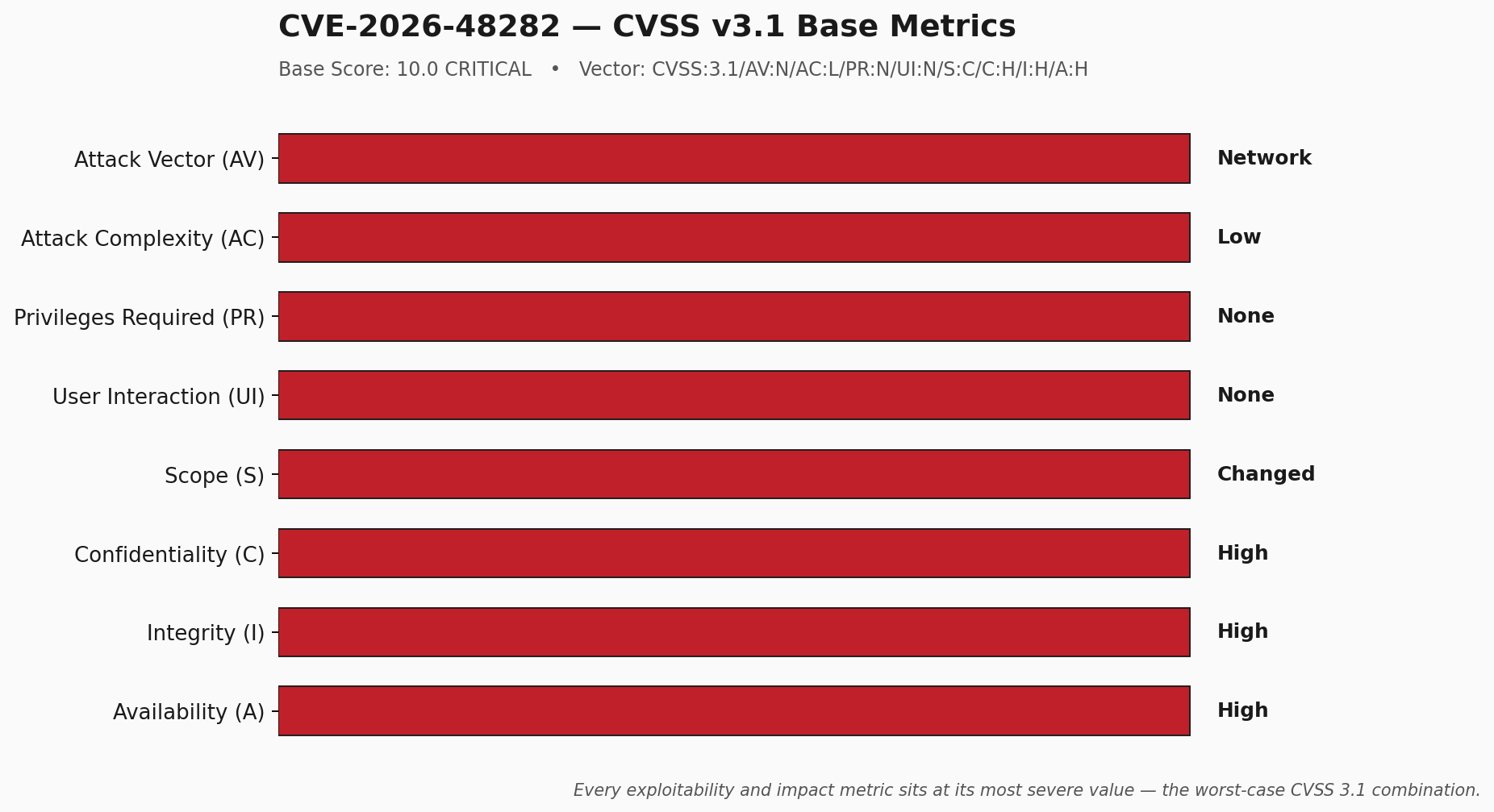
| CVSS Score | 10.0 (CVSS v3.1) |
| CVSS Vector | CVSS:3.1/AV:N/AC:L/PR:N/UI:N/S:C/C:H/I:H/A:H |
| Vulnerability Type | Path Traversal leading to Remote Code Execution (CWE-22) |
| Affected Products | Adobe ColdFusion 2025 (Update 9 and earlier); Adobe ColdFusion 2023 (Update 20 and earlier) |
| Attack Vector | Network — unauthenticated, no user interaction (requires RDS enabled with RDS auth disabled) |
| Actively Exploited | Yes — in the wild (CISA KEV, added 8 July 2026; technical write-up public) |
| Patch Available | Yes — ColdFusion 2025 Update 10 / ColdFusion 2023 Update 21 |
| Disclosure Date | 30 June 2026 (Adobe bulletin APSB26-68) |

What is CVE-2026-48282?
CVE-2026-48282 is a path traversal vulnerability in Adobe ColdFusion’s Remote Development Services (RDS), specifically its FILEIO handler. RDS is a legacy feature that lets a developer’s IDE — historically ColdFusion Builder, Dreamweaver, or the Eclipse plugin — talk to a running ColdFusion server over HTTP to browse the filesystem, run database queries and assist with debugging. FILEIO is the piece of RDS that reads, writes, renames and deletes files on the server on the IDE’s behalf.
Before the patch, FILEIO trusted the file path supplied in an incoming request and handed it straight to the filesystem API without canonicalising it or checking it stayed inside an approved directory. That let an attacker point the handler at paths well outside its intended scope — including the ColdFusion web root — and read or write files there. Adobe rated the flaw CVSS 10.0: the maximum possible score, reflecting network reachability, no authentication, no user interaction, and full compromise of confidentiality, integrity and availability once file write is achieved.
Adobe disclosed and patched CVE-2026-48282 on 30 June 2026 as part of security bulletin APSB26-68, a broader round of critical- and high-severity ColdFusion fixes. Adobe said at the time it was not aware of any in-the-wild exploitation — that changed within days.
How the Adobe ColdFusion exploit works
In plain terms: the flaw turns a “write a file” request into “write a file anywhere,” including into a folder the web server will happily execute code from. An attacker who can reach the RDS endpoint sends one HTTP request that writes a small ColdFusion script (a .cfm web shell) into the site’s document root, then requests that script directly to run commands on the server.
The technical chain, as documented by researchers who examined the patch:
- Reconnaissance. The attacker fingerprints ColdFusion hosts with RDS exposed, typically by probing
/CFIDE/main/ide.cfmon the default RDS port (8500) or over HTTPS. - Path traversal / arbitrary write. A
POSTrequest to/CFIDE/main/ide.cfm?ACTION=FILEIOcarries a length-prefixed RPC body specifying aWRITEoperation and a target file path. Because the handler didn’t canonicalise or bounds-check that path, an attacker could supply an absolute path (or../traversal) that resolves inside the web root instead of the sandboxed RDS working directory. - Web shell drop. The attacker writes a minimal
.cfmfile containing a<cfexecute>call that runs whatever command is passed in a URL parameter. - Execution. The attacker requests the newly-planted file directly (e.g.
GET /shell.cfm?cmd=whoami). ColdFusion parses and executes it with the privileges of the ColdFusion service account — on many Windows installs, that’s a highly privileged local account. - Post-exploitation. From there, typical objectives are reading ColdFusion’s configuration for database credentials, deploying a more durable backdoor, and pivoting into the internal network.
Non-operational illustration of the flawed logic (patched behaviour shown for contrast) — this is not working exploit code:
// Vulnerable (pre-patch): path handed straight to the filesystemString filename = readFromRpcBody();File target = FileServlet.this.getFile(filename); // no bounds check// Patched: canonical resolution + directory allow-list enforced firstString filename = readFromRpcBody();File target = FileServlet.this.getCanonicalFile(filename);// RdsFileSecurity.resolveCanonical() rejects absolute paths, "..", null bytes,// and anything that resolves outside the approved RDS directory
The crucial pre-condition: RDS has to be enabled, and RDS authentication has to be disabled. Neither is the out-of-the-box default, but RDS is a long-standing legacy feature that gets switched on for development convenience and then forgotten on production hosts — exactly the scenario this flaw targets.

Is CVE-2026-48282 actively exploited?
Yes. Adobe’s own advisory said it had no evidence of exploitation at patch time (30 June 2026), but that changed fast. Independent researchers at watchTowr published a detailed technical analysis of the ColdFusion APSB26-68 patch batch, and according to the vulnerability intelligence platform KEVIntel, in-the-wild exploitation attempts against CVE-2026-48282 were captured on its honeypot network within minutes of that write-up going live — roughly two hours after the technical details became public, per KEVIntel founder Ryan Dewhurst.
The Canadian Centre for Cyber Security subsequently confirmed exploitation in attacks based on open-source reporting. On 8 July 2026, the US Cybersecurity and Infrastructure Security Agency (CISA) added CVE-2026-48282 to its Known Exploited Vulnerabilities (KEV) catalogue, giving US federal civilian agencies until 10 July 2026 to remediate under Binding Operational Directive 26-04.
No named threat actor or group has been publicly attributed to the activity as of this writing, and it isn’t yet clear how widespread exploitation is beyond the confirmed honeypot hits — the Shadowserver Foundation tracks roughly 750 internet-facing ColdFusion servers in total, but how many are unpatched and have RDS misconfigured in the vulnerable way is unknown. We’ll update this post if attribution or scale details are confirmed.

How to fix CVE-2026-48282: remediation & mitigation
Patch: Upgrade to ColdFusion 2025 Update 10 or ColdFusion 2023 Update 21 immediately — these are the fixed releases named in Adobe bulletin APSB26-68 (30 June 2026).
If you can’t patch immediately:
- Disable RDS entirely unless it’s actively required for development — it has no place on an internet-facing production server.
- If RDS must stay on, enable RDS authentication and restrict access to trusted administrator IP ranges only.
- Block external access to
/CFIDE/administrator,/CFIDE/main/ide.cfm,/CFIDE/main/websocket.cfmand other ColdFusion management endpoints at the network edge or WAF. - Deploy WAF rules to catch path-traversal sequences (
../,..\) and suspiciousFILEIOrequests toide.cfm.
After patching:
- Hunt for unauthorised
.cfm,.cfcor.cfmlfiles created in the web root or/CFIDE/directories, particularly anything written since 30 June 2026. - Rotate ColdFusion administrator, database and service-account credentials if a compromise is suspected.
- Run ColdFusion under a dedicated, least-privilege service account and restrict write access to the web root.
- Terminate and review any suspicious active sessions.
Detection / IOCs: Look for POST requests to /CFIDE/main/ide.cfm?ACTION=FILEIO in web server logs, especially those carrying absolute Windows/Linux paths or ../ sequences in the body, followed shortly by GET requests to a newly-created .cfm file. Centre for Cybersecurity Belgium and the Canadian Centre for Cyber Security advisories are worth monitoring for updated indicators as the picture develops.
Frequently asked questions
Is my ColdFusion server vulnerable if I’ve never touched RDS?
Probably not exploitable via this specific flaw — RDS must be enabled and RDS authentication disabled for CVE-2026-48282 to be reachable. Neither is the default. But it’s worth checking explicitly rather than assuming, since RDS is sometimes left on from earlier development work.
Do I need to patch even if RDS is disabled on my server?
Yes. Patch anyway — RDS could be re-enabled later by mistake, and APSB26-68 fixed multiple other ColdFusion flaws alongside this one.
Is there public exploit code available?
Researchers (including watchTowr and Resecurity) have published detailed technical write-ups covering the vulnerable code path and proof-of-concept request formats. Treat any internet-facing ColdFusion host with RDS enabled as at immediate risk.
What’s the real-world impact if I’m compromised?
Full remote code execution in the context of the ColdFusion service account, which on many Windows deployments runs with high privileges — meaning file system access, credential theft from ColdFusion’s configuration, and a foothold for lateral movement into the wider network.
Sources & further reading
- Adobe Security Bulletin APSB26-68 — ColdFusion
- NVD — CVE-2026-48282 Detail
- Help Net Security — Attackers exploit critical Adobe ColdFusion vulnerability (CVE-2026-48282)
- SecurityWeek — Critical Adobe ColdFusion Vulnerability Exploited in Attacks
- Resecurity — CVE-2026-48282: Adobe ColdFusion RDS Path Traversal Leading to RCE
- watchTowr Labs — technical analysis of APSB26-68
- CISA Known Exploited Vulnerabilities Catalog
- Centre for Cybersecurity Belgium advisory
ZeroDayHub tracks critical vulnerabilities as they break. Subscribe for updates.




Leave a Reply