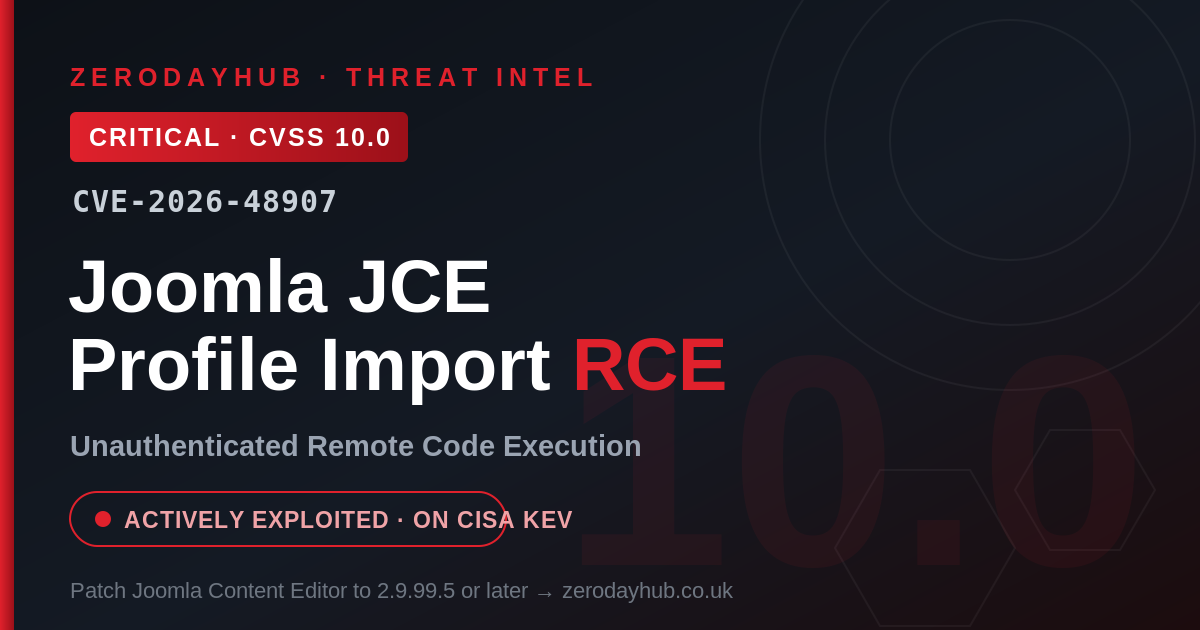
TL;DR: CVE-2026-48907 is a maximum-severity (CVSS 10.0) flaw in the hugely popular JCE (Joomla Content Editor) extension. It lets an unauthenticated attacker create a rogue editor profile, upload a PHP file and run it on the server – a web shell and full server takeover. CISA confirms it is already being exploited in the wild. If you run JCE, update to version 2.9.99.5 or later today.
Key takeaways
- What: Unauthenticated remote code execution (RCE) in the Joomla Content Editor (JCE) extension via the profile-import feature.
- Severity: CVSS 10.0 (Critical) no login, no user interaction.
- Status: Actively exploited; added to the CISA Known Exploited Vulnerabilities (KEV) catalog on 16 June 2026.
- Fix: Upgrade JCE to 2.9.99.5 (or the hardened 2.9.99.6) immediately.
- Risk: Public exploit and Nuclei template exist, enabling mass automated attacks on internet-facing Joomla sites.
CRITICAL Joomla JCE Profile Import RCE CVE-2026-48907
| CVSS Score | 10.0 (CVSS v3.1) |
| CVSS Vector | CVSS:3.1/AV:N/AC:L/PR:N/UI:N/S:C/C:H/I:H/A:H |
| Vulnerability Type | Improper access control leading to unauthenticated file upload / RCE (CWE-284 / CWE-434) |
| Affected Products | Widget Factory JCE (Joomla Content Editor) extension for Joomla, versions 1.0.0 through 2.9.99.4. |
| Attack Vector | Network — remote, unauthenticated, no user interaction required. |
| Actively Exploited | Yes — in the wild. Added to CISA KEV on 16 June 2026; public exploit code / Nuclei template available. |
| Patch Available | Yes — fixed in JCE 2.9.99.5 (3 June 2026); further hardening in 2.9.99.6 (6 June 2026). |
| Disclosure Date | CVE published 5 June 2026; patch released 3 June 2026. |
What is CVE-2026-48907?
JCE — the Joomla Content Editor — is one of the most widely installed editor extensions in the Joomla ecosystem, sitting on a huge number of small-business sites, brochureware and CMS-driven portals. That ubiquity is exactly what makes CVE-2026-48907 so dangerous. Rated a perfect 10.0, the flaw lets a completely unauthenticated attacker abuse JCE’s editor-profile machinery to upload and execute arbitrary PHP on the underlying server. No login, no admin account, no user interaction — just a crafted request to a vulnerable endpoint. CISA added it to the Known Exploited Vulnerabilities catalog on 16 June 2026 after confirming real-world abuse, and ordered federal agencies to remediate by 19 June.

How the Joomla JCE exploit works
The root cause is improper access control around JCE’s editor-profile import feature. In a correctly secured install, only authenticated administrators should be able to create or import editor profiles — the JSON/XML configuration objects that define which buttons, plugins and file-handling behaviour an editor exposes. In affected versions the access checks on that import path are insufficient, so an unauthenticated visitor can reach it directly.
From there the attack is a textbook chain into remote code execution. The attacker imports a rogue editor profile that grants permissive file-upload behaviour, then uses JCE’s own file/media handling to upload a PHP file rather than a benign asset. Because the file lands inside the web root and the server happily executes .php, requesting it back over HTTP runs the attacker’s code — typically a web shell that hands over a persistent, unauthenticated backdoor with full read/write access to the filesystem. Widget Factory’s own changelog describes the underlying issue plainly: “insufficient access controls permitted unauthenticated users to upload editor profiles.”
Two things make this worse than the average upload bug. First, it needs no account of any kind, so sites with public registration disabled are not safe. Second, the attack is fully scriptable — a public Nuclei template and proof-of-concept tooling already exist — so it lends itself to mass, automated scanning of internet-facing Joomla sites.

POST /index.php?option=com_jce&task=profiles.import HTTP/1.1Host: target-joomla-siteContent-Type: multipart/form-data; boundary=----x# 1. Import a rogue editor profile with permissive upload rules# 2. Use the resulting upload path to drop shell.php# 3. GET /images/shell.php -> web shell / RCE
(Illustrative only — exact endpoint and parameters vary by version.)
Is CVE-2026-48907 being actively exploited?
Yes. CISA added CVE-2026-48907 to its KEV catalog on 16 June 2026 specifically because of evidence of active exploitation, and set a remediation deadline of 19 June 2026 for Federal Civilian Executive Branch agencies — an unusually short window that signals how seriously the agency is treating it.
Security vendors tracking the flaw report that attacks are automated and that working exploit code is public, including a community Nuclei template for mass detection/exploitation. The observed pattern is consistent with the vulnerability’s design: import a rogue profile, drop a PHP web shell, establish a persistent backdoor. Several write-ups note Linux web servers as the primary target surface, which is where the bulk of Joomla hosting lives. At the time of writing, granular detail on specific threat actors and victim counts is limited — but with a 10.0 score, a public PoC and confirmed in-the-wild use, every internet-facing JCE install should be treated as a live target.
How to fix CVE-2026-48907: remediation & mitigation
Patch: Upgrade JCE to 2.9.99.5 (released 3 June 2026) or later. Widget Factory shipped additional hardening in 2.9.99.6 (6 June 2026), so updating straight to the latest 2.9.99.6+ build is the safest move. The update can be applied through Joomla’s standard Extensions → Manage → Update workflow.
If you can’t patch immediately
- Block or restrict access to the JCE component endpoints (
com_jceprofile/import and file-upload tasks) at the web server or WAF layer. - Add WAF rules to deny multipart uploads of
.php/.phtml/.php5and similar executable extensions to the media/upload paths. - Consider temporarily disabling the JCE extension on high-exposure sites until the update is applied.
After patching
Patching does not remove a backdoor that’s already in place. Assume compromise if the site was internet-facing and unpatched. Audit the web root for unexpected .php files (especially in images/, media/ and JCE upload directories), review the #__jce_profiles table for unknown profiles, rotate all admin and database credentials, and force-invalidate active sessions.
Detection & indicators of compromise (IOCs)
Hunt web/access logs for unauthenticated POSTs to com_jce profile-import and file-upload tasks, followed by GET requests to freshly created .php files under upload directories. Newly written PHP files with recent timestamps, unfamiliar JCE editor profiles, and outbound connections from the web server to unknown hosts are all strong indicators of compromise.
Frequently asked questions
What versions of JCE are affected by CVE-2026-48907?
Widget Factory JCE (Joomla Content Editor) versions 1.0.0 through 2.9.99.4 are vulnerable. The flaw is fixed in JCE 2.9.99.5, with extra hardening in 2.9.99.6.
Do I need a Joomla account for an attacker to exploit this?
No. CVE-2026-48907 is unauthenticated, requires no user interaction, and works even when public user registration is disabled. Any internet-facing site running a vulnerable JCE version is at risk.
How do I know if my Joomla site has already been compromised?
Look for unfamiliar editor profiles in the #__jce_profiles table, recently created .php files in images/, media/ or JCE upload folders, and access-log entries showing unauthenticated POSTs to com_jce import/upload tasks followed by GETs to new PHP files.
What should I do right now?
Update JCE to 2.9.99.5 or later immediately, then check for indicators of compromise. If the site was internet-facing while unpatched, treat it as potentially breached: rotate credentials, kill active sessions and audit the web root.
Sources & further reading
- CISA — Adds One Known Exploited Vulnerability to Catalog (16 June 2026)
- NVD — CVE-2026-48907 Detail
- The Hacker News — CISA Warns of Actively Exploited Joomla JCE Flaw
- YesWeHack — Unauthenticated RCE in the Joomla Content Editor extension
- Widget Factory — JCE editor changelog (2.9.99.5 / 2.9.99.6)
- SecurityWeek — Joomla, LiteSpeed Vulnerabilities Exploited in Attacks
- Security Affairs — CISA adds Joomla Content Editor (JCE) flaw to KEV
ZeroDayHub tracks critical vulnerabilities as they break. Subscribe for updates.


Leave a Reply